Squads V4 Integration
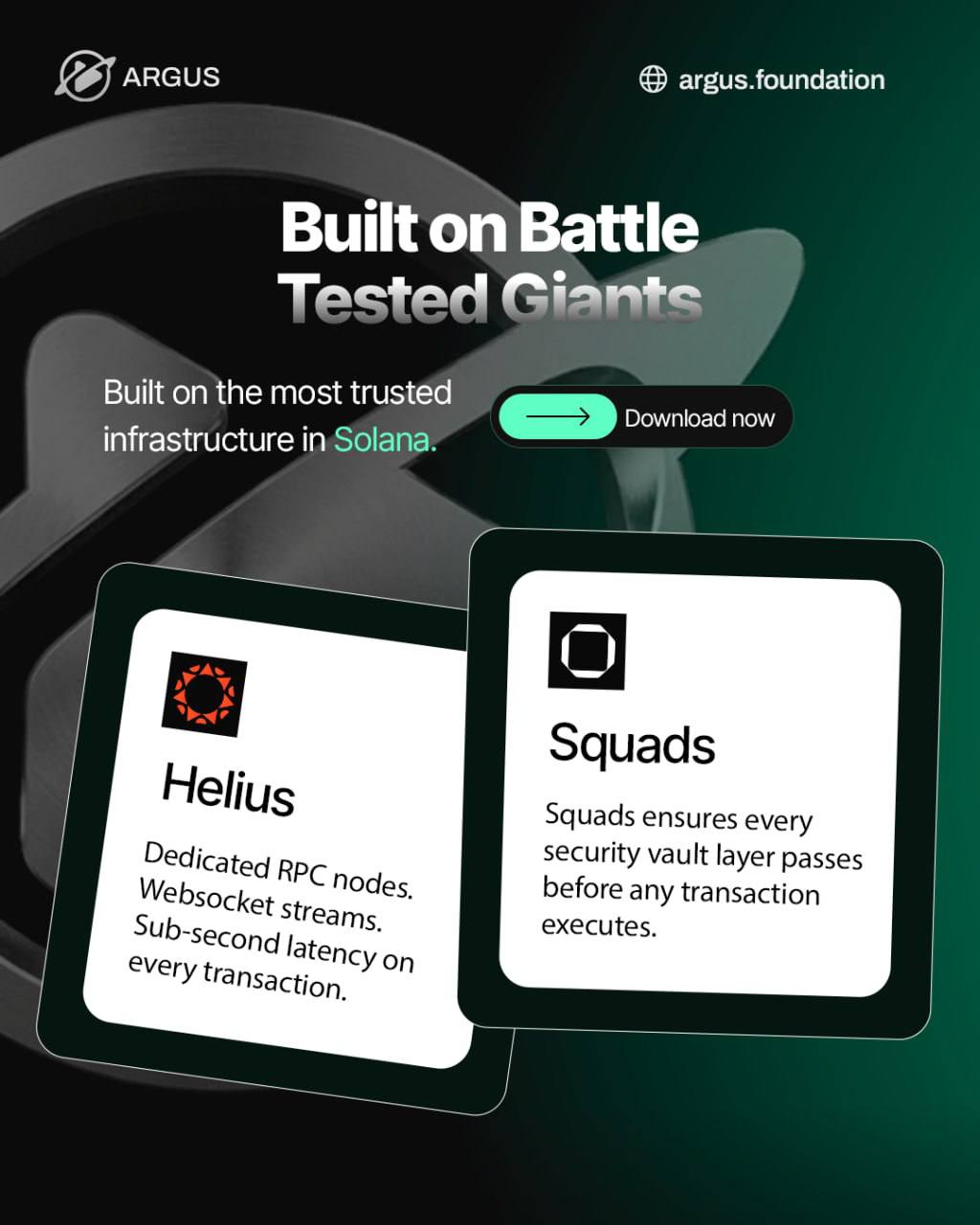
ARGUS leverages Squads Protocol V4, Solana's premier multisig infrastructure, to implement its Argus Vault security model. This integration provides on-chain security guarantees that exist independently of ARGUS infrastructure.
What is Squads Protocol?
Squads Protocol is a battle-tested smart contract platform for multisig and program management on Solana. It's used by leading protocols including Jupiter, Mango Markets, and numerous DAOs to secure billions of dollars in on-chain assets.
Key Features
- Multisig Wallets: M-of-N signature threshold requirements
- Transaction Proposals: On-chain proposal and approval workflow
- Vault System: Segregated asset storage with controlled access
- Program Authority: Upgrade authority management for smart contracts
- Time Locks: Optional delays for security-critical operations
- Battle-Tested: Audited, proven in production with major protocols
Why Squads for ARGUS?
- On-Chain Security: Multisig logic enforced by smart contract, not server
- Trustless Architecture: ARGUS server cannot bypass security even if compromised
- Proven Track Record: Used by major DeFi protocols securing $100M+
- Solana Native: Optimized for Solana's architecture
- Open Source: Fully auditable implementation
- Standard Compliance: Compatible with Solana's standard token programs
Squads V4 Architecture
Program Address
Program ID: SQDS4ep65T869zMMBKyuUq6aD6EgTu8psMjkvj52pCf
This is the on-chain program that governs all multisig operations. It's deployed on Solana mainnet and cannot be modified.
Core Concepts
1. Multisig Account
The multisig account is the control structure that defines:
- Who can propose transactions (members)
- How many signatures are required (threshold)
- Configuration and permissions
PDA Derivation:
const [multisigPDA] = PublicKey.findProgramAddressSync(
  [
    Buffer.from("multisig"),
    createKey.publicKey.toBuffer(),     // Creator public key
    Buffer.from("ARGUS"),                // Optional memo/identifier
  ],
  SQUADS_PROGRAM_ID
);
2. Vault Account
The vault is the asset container that holds actual funds:
PDA Derivation:
const [vaultPDA] = PublicKey.findProgramAddressSync(
  [
    Buffer.from("vault"),
    multisigPDA.toBuffer(),              // Parent multisig
    new Uint8Array([vaultIndex]),        // Vault number (0 for primary)
  ],
  SQUADS_PROGRAM_ID
);
Characteristics:
- Owned by the multisig (can only be controlled via proposals)
- Can hold SOL and SPL tokens
- Cannot sign transactions itself (controlled by multisig authority)
- Rent-exempt (requires ~0.01 SOL minimum balance)
3. Transaction Proposal
A proposal is an on-chain record of a pending transaction:
PDA Derivation:
const [proposalPDA] = PublicKey.findProgramAddressSync(
  [
    Buffer.from("transaction"),
    multisigPDA.toBuffer(),
    new Uint8Array(
      new BigInt(transactionIndex).toArrayLike(Buffer, "le", 8)
    ),
  ],
  SQUADS_PROGRAM_ID
);
ARGUS Multisig Configuration
Member Structure
ARGUS uses a 2-of-2 multisig configuration:
- Member 1: User's Wallet Key (transaction creator & signer)
- Member 2: ARGUS Backend Server (co-signer after verification)
- Threshold: 2 of 2 (both signatures required)
Security Model
Key Insight: Both signatures are required, so:
- User alone cannot execute transactions (needs server approval)
- Server alone cannot execute transactions (needs user proposal + signature)
- Attacker with user's key cannot execute (needs server approval, which requires passing security layers)
- Compromised server cannot steal funds (cannot create valid proposals without user's signature)
This creates a trustless security model where neither party has unilateral control.
Transaction Flow
Complete End-to-End Flow
- User Initiates Transaction: User creates transaction request
- Create Proposal On-Chain: ARGUS creates Squads V4 multisig proposal
- User Signs Proposal: User approves the proposal
- Security Verification: ARGUS backend verifies all security layers
- Server Co-Signs Proposal: Server co-signs if all verifications pass
- Execute Transaction: Transaction executes via Squads V4
- Confirmation: Transaction confirmed on Solana network
On-Chain Security Guarantees
What Squads Enforces
- Threshold Requirement: Transaction CANNOT execute without 2 signatures
- Member Verification: Only registered members can sign proposals
- Proposal Immutability: Approved proposals cannot be altered
- Vault Control: Only multisig authority can move funds from vault
- Transaction Ordering: Proposals execute in sequential order
What ARGUS Adds
The Squads contract only verifies signatures. ARGUS adds authorization logic:
- Voice biometric verification
- Geographic location verification
- Hardware key verification
- Bluetooth device verification
- Platform biometric verification
Critical: Even if an attacker bypasses ARGUS's off-chain verification, they still need the server's private key to sign proposals.
Account Structure
When you create a Argus Vault, these accounts are created on Solana:
- Multisig Account: Stores multisig configuration (~0.002 SOL rent)
- Vault Account: Holds actual funds (rent-exempt minimum ~0.001 SOL)
- Transaction Proposals: Created per transaction (~0.005 SOL rent, refunded when executed)
Cost Breakdown
Creating a Argus Vault
- Multisig Account: ~0.002 SOL
- Vault Account: ~0.001 SOL
- Transaction Fee: ~0.00001 SOL
- Total: ~0.003 SOL (one-time setup cost)
Per-Transaction Costs
- Create Proposal: ~0.005 SOL (rent, refunded when executed)
- Approve (User): ~0.000005 SOL (network fee)
- Approve (Server): ~0.000005 SOL (network fee)
- Execute: ~0.000005 SOL (network fee)
- Total: ~0.005 SOL (proposal rent refunded)
Advantages Over Traditional Multisig
Traditional 2-of-2 Multisig
Problems:
- Requires coordinating two people
- Other party may be unavailable
- Social trust required
- Complex key management
ARGUS Argus Vault
Advantages:
- Single user control (no coordination needed)
- Server always available
- Security layers instead of second person
- User maintains sovereignty
Comparison to Hardware Wallets
| Feature | Ledger/Trezor | ARGUS Argus Vault |
|---|---|---|
| Security Model | Physical device | Multi-layered verification |
| Attack Surface | Device firmware | Device + biometrics + location |
| Convenience | Must connect device | Browser-based, multiple factors |
| Transaction Speed | 30-60 seconds | 30-60 seconds |
| Loss Recovery | Seed phrase only | Seed phrase + re-enrollment |
| Cost | $50-$200 hardware | Free (software only) |
| Multi-Device | Must carry device | Works from registered location |
| Geographic Security | No | Yes |
| Biometric Security | No (some models) | Yes (voice + platform) |
| Open Source | Closed firmware | Open source |
Key Takeaways
- On-chain enforcement via Squads V4 provides trustless security
- 2-of-2 multisig requires both user and server signatures
- Server co-signs only after verifying all security layers
- Independent security exists even if ARGUS infrastructure is compromised
- Proven infrastructure used by major DeFi protocols
Squads V4 integration ensures that Argus Vault security is not just promised—it's enforced on-chain.
Next Steps
- Multisig Enforcement - Deep dive into enforcement mechanisms
- How Argus Vault Security Works - Complete security flow
- Wallet Architecture Overview - Understanding the system