Hot Wallet vs ARGUS
Understanding the fundamental differences between traditional hot wallets and ARGUS helps clarify why ARGUS represents a new paradigm in wallet security.
Traditional Hot Wallets
How They Work
Traditional hot wallets (like MetaMask, Phantom, Solflare) operate on a simple principle:
- Generate or import a private key
- Store the key (encrypted) on your device
- Sign transactions with the key
- Broadcast to the network
That's it. No additional verification, no context checks, no second line of defense.
The Security Model
Private Key → Signature → Transaction Executes
If you have the key, you can execute any transaction. Period.
Limitations
Single Point of Failure: The private key is everything. If compromised, funds are immediately accessible to the attacker.
No Context Awareness: The wallet cannot verify:
- Who is signing
- Where the transaction originates
- When it should be allowed
- How it's being approved
Remote Vulnerability: An attacker thousands of kilometers away can drain funds as easily as if they were next to you.
No Recovery: Once a key is compromised, there's no way to revoke access or require additional verification.
ARGUS: Hot Wallet Experience, Cold Wallet Security
How ARGUS Works
ARGUS provides the same user experience as a hot wallet:
- Simple, intuitive interface
- Fast transaction signing
- Seamless DApp integration
- No complex workflows
But under the hood, ARGUS adds multiple security layers:
- On-Chain Multisig: Every secure vault uses Squads V4 multisig
- Geographic Verification: Transactions require physical presence
- Biometric Verification: Voice and platform biometrics
- Hardware Verification: USB keys and Bluetooth devices
- Environmental Checks: Network, device, and context verification
The Security Model
Private Key + Location + Voice + Hardware + Environment → Verification → Transaction Executes
Even with the key, an attacker must meet all environmental requirements.
Advantages
Multiple Points of Defense: Even if one layer fails, others remain active.
Context Awareness: ARGUS verifies real-world context before allowing transactions.
Remote Attack Prevention: Physical presence is required, making remote attacks impossible.
Recovery Options: Multiple security layers provide redundancy and recovery paths.
Side-by-Side Comparison
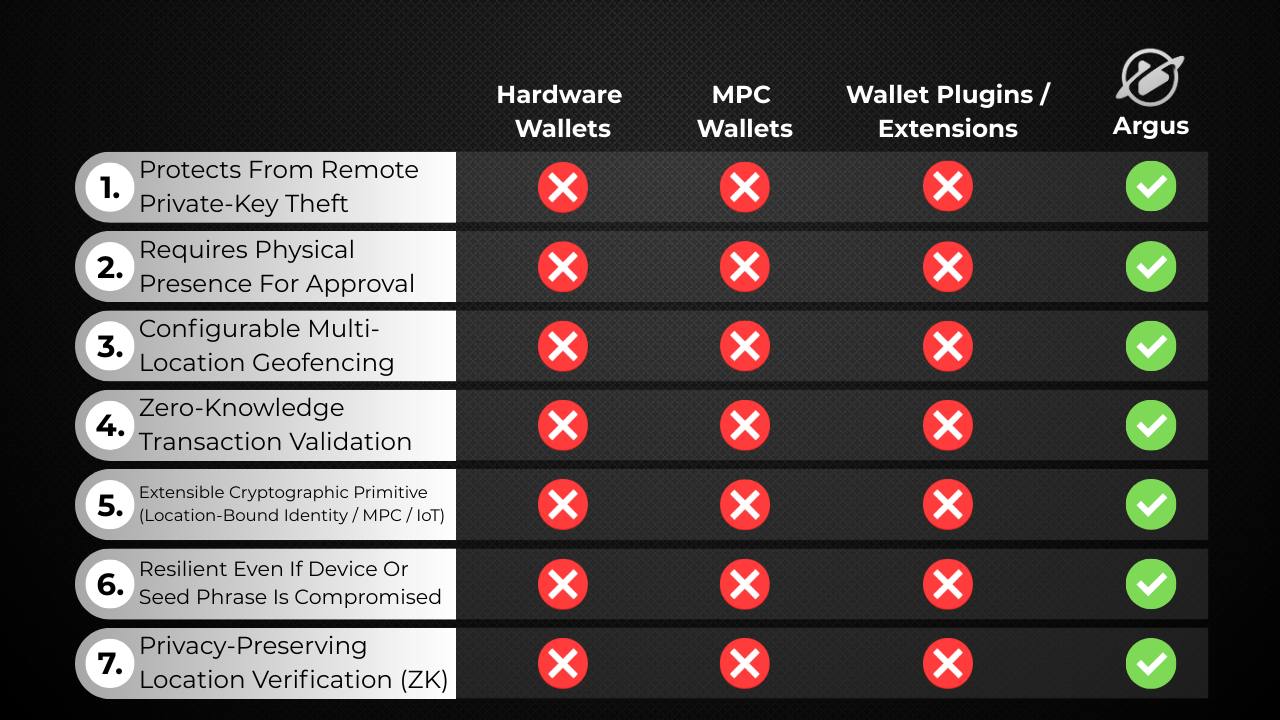
| Feature | Traditional Hot Wallet | ARGUS |
|---|---|---|
| User Experience | Simple, fast | Simple, fast |
| Transaction Speed | Instant | Instant (standard wallet) or 30-60s (Argus Vault) |
| Security Layers | 1 (private key) | 5+ (key + location + voice + hardware + environment) |
| Remote Attack Protection | None | Complete |
| Context Verification | No | Yes |
| Multisig Enforcement | No | Yes (invisible) |
| Physical Presence Required | No | Yes (for Argus Vault) |
| Biometric Verification | No | Yes |
| Hardware Verification | No | Yes (optional) |
| Self-Custodial | Yes | Yes |
| Complexity | Low | Low (user-facing) |
Use Case Comparison
Daily Transactions
Traditional Hot Wallet: Perfect for frequent, small transactions. Fast and convenient.
ARGUS Standard Wallet: Same experience. Fast and convenient, with better key protection.
Winner: Tie (both excellent for daily use)
High-Value Holdings
Traditional Hot Wallet: Risky. Single point of failure makes large holdings vulnerable.
ARGUS Argus Vault: Secure. Multiple layers of protection make remote attacks impossible.
Winner: ARGUS (significantly more secure)
DeFi Interactions
Traditional Hot Wallet: Works well, but vulnerable to phishing and malicious contracts.
ARGUS Standard Wallet: Works well, with additional protection against key exfiltration.
Winner: ARGUS (better protection)
Long-Term Storage
Traditional Hot Wallet: Not recommended. Too vulnerable for long-term holdings.
ARGUS Argus Vault: Ideal. Combines security with accessibility.
Winner: ARGUS (much better for long-term storage)
The ARGUS Approach
ARGUS doesn't replace hot wallets—it makes them secure.
Standard Wallet (Hot Wallet Equivalent)
For daily use, ARGUS provides a standard wallet that works exactly like a traditional hot wallet:
- Fast transactions
- Simple interface
- Full DApp compatibility
- No additional friction
Use for: Daily spending, DeFi interactions, NFT trading, frequent transactions.
Argus Vault (Secure Storage)
For high-value holdings, ARGUS provides Argus Vault with multi-layer security:
- Geographic verification
- Voice biometrics
- Hardware keys
- Multisig enforcement
Use for: Long-term holdings, large investments, emergency funds, maximum security.
Key Takeaways
- ARGUS provides hot wallet convenience with cold wallet security
- Standard wallet works like traditional hot wallets
- Argus Vault adds multiple security layers without sacrificing usability
- You choose the security level based on your needs
- Both options are self-custodial and user-controlled
ARGUS doesn't force you to choose between convenience and security—you get both.
Next Steps
- Private Keys & Why They Fail - Understanding the fundamental flaw
- What Is a Argus Vault - Deep dive into Argus Vault
- ARGUS as a Wallet - How multisig is made invisible